Mosticare Domo Pop, Freestanding Mosquito Dome
A certified mosquito dome that needs no ceiling.
- Factory-impregnated permethrin, bound into the fibre, never sprayed
- Three-year effective lifecycle under normal use
- Ships with recycled-cotton carry sachet and deployment card
A WHO-standard freestanding mosquito net that pops up into a self-supporting dome in seconds, no ceiling, no frame, no anchor point required. Polyester mesh at 156-count density, 600 g packed, three-year effective lifecycle. Built for road-trip travel, hostel floors, festival bivvies, earthquake-relief field use, and every bed where there is simply nothing overhead to hang from.
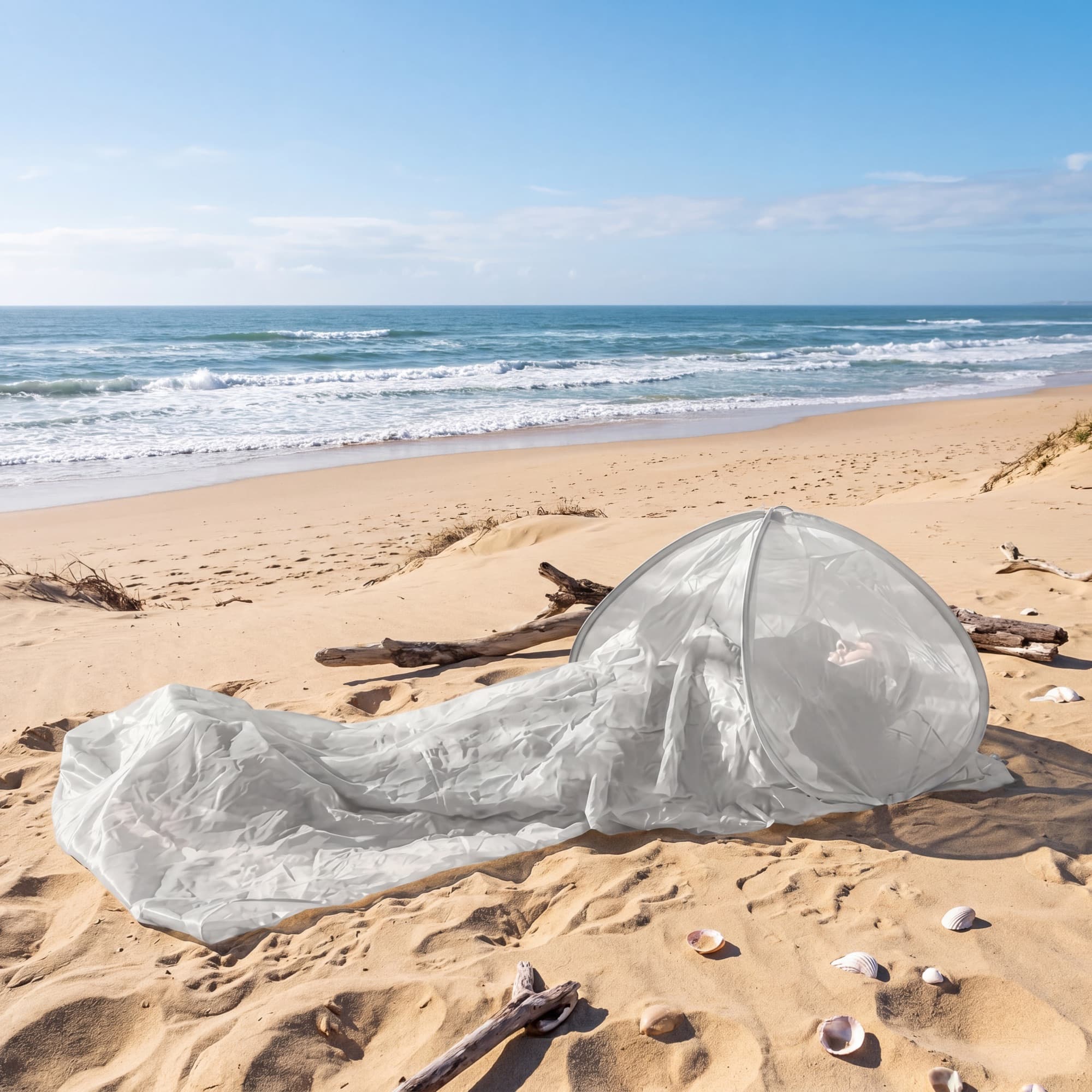
There is a specific kind of travel bed that defeats every hanging mosquito net: the mattress on the floor of a hostel, the sofa in a friend's lounge, the bunk in a van conversion, the camp bed in an emergency-response tent, the fold-out in a wooden hut on a beach in Mozambique. No ceiling hook, no headboard, no four-corner frame, nothing overhead to tie off to. For decades the honest answer to "what do I hang a net from?" in those scenarios has been "you can't." The Mosticare Domo Pop is the answer: a WHO-standard freestanding mosquito net that erects itself into a self-supporting dome in seconds, encloses a single sleeping body cleanly on all sides, and collapses flat back into a disc when you're ready to move.
What this net is, exactly
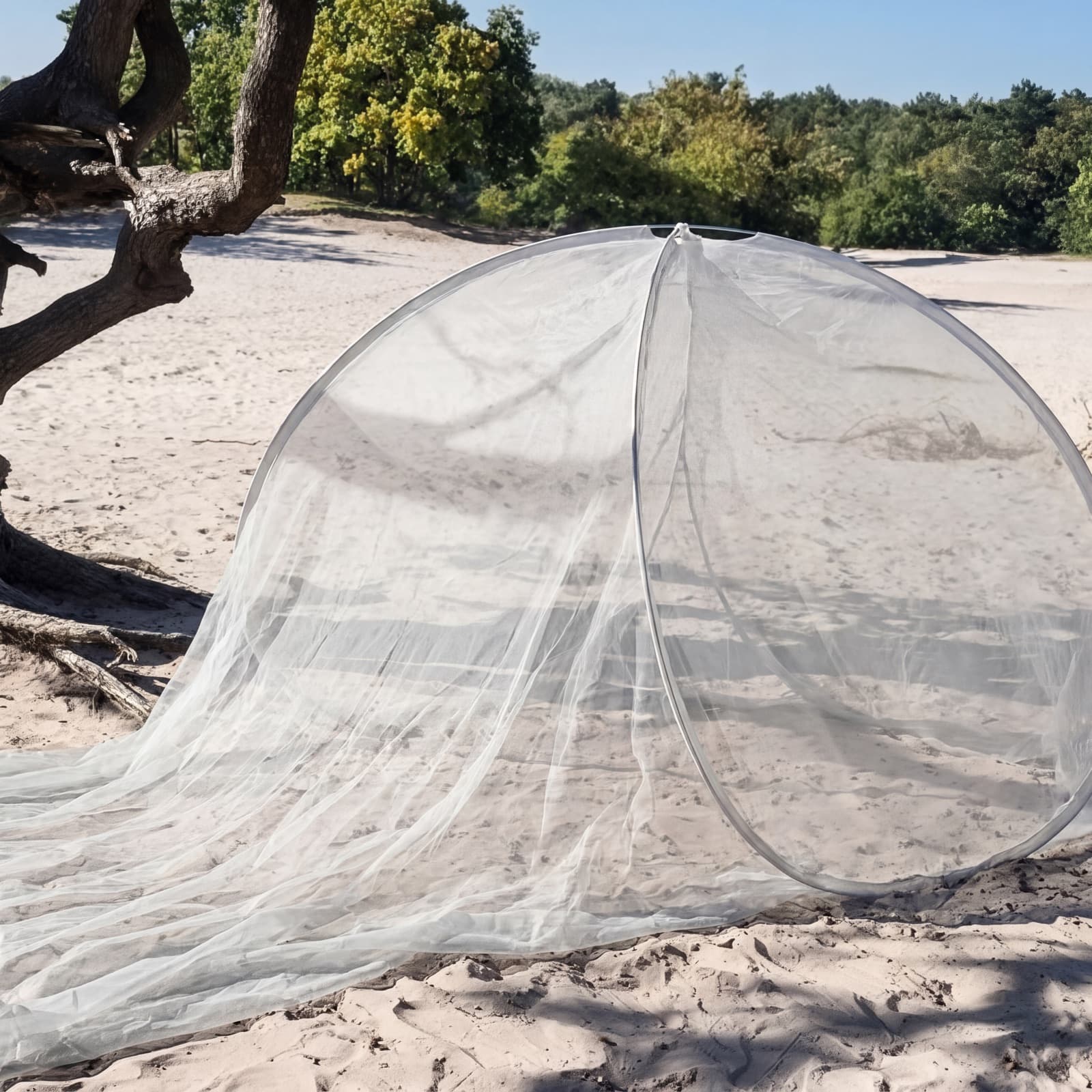
The Domo Pop is a freestanding pop-up dome measuring L 270 × W 85 × H 56 cm when deployed, a body-length dome with enough width for a single sleeper and enough height to sit up on your elbows. The frame is an internal sprung rim that self-erects the moment the dome is released from its pack; no poles to assemble, no pegs to drive, no time lost on a hostel floor at 1 a.m.
Its mesh is knitted from durable 75-denier polyester at a 156-count density (25 holes per cm²), the same WHO-standard mesh used across the full Mosticare range. The fibre is factory-impregnated with permethrin at 9 g/kg (0.9% w/w), a WHO-recommended pyrethroid bound into the yarn during manufacture rather than sprayed on, so it stays locked into the fibre, does not leach meaningfully onto skin, and does not release into the air inside the dome.
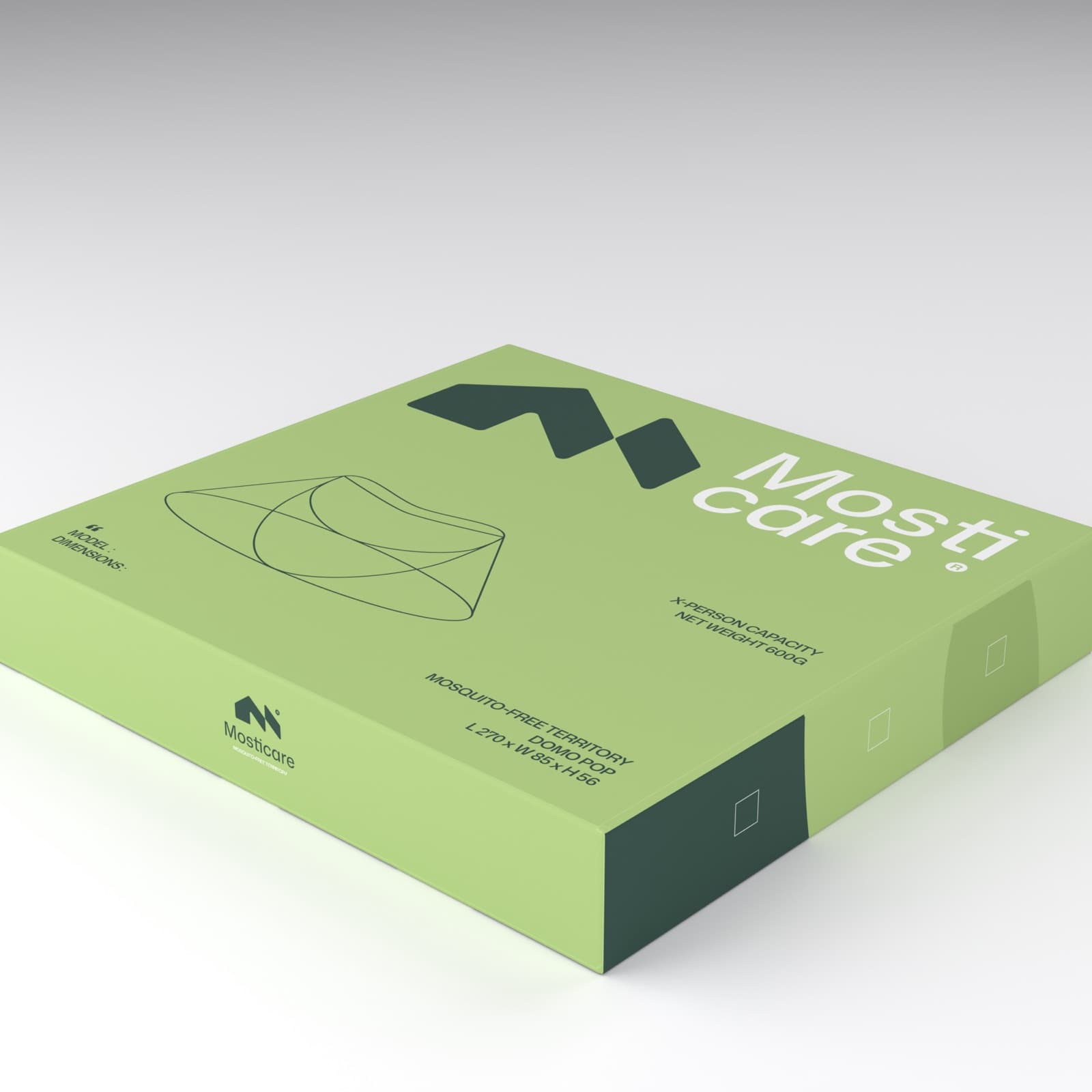
The Domo Pop is WHO-standard as a long-lasting insecticidal net and authorized for European Union market release under the EU Biocidal Products Regulation (authorization EU-0026815-0000 2032). Packed weight is 600 g and the collapsed disc fits into a flat travel carton of 330 × 310 × 55 mm, luggage-ready rather than bikepacker-light. Colour: soft off-white.
Why a freestanding barrier is the right approach when there's nothing to hang from
A hanging net needs a ceiling. The global travel bed does not always have one. The mattress on a cabin floor, the sofa in a friend's lounge, the temporary bed in a guest room where drilling a ceiling hook is not allowed, the field bed in a disaster-response tent, all of these scenarios have been the justification for the worst mosquito-protection compromises on record: tropical-strength aerosol sprays, coils burning through the night, plug-in diffusers pumping into a closed room.
The Domo Pop collapses that bad choice into a physical barrier you can set up anywhere. It stands on its own frame, so the ceiling is irrelevant. The permethrin impregnated into its mesh reinforces the barrier at the point of contact, bound into the yarn at a deliberately minimal dose and never diffused through the dome's enclosed air, so the chemistry stays on the outside of the mesh and the air you sleep in stays as clean as the room around it will allow.
Who it's for
The Domo Pop is for travellers, field workers, disaster-response staff, festival-goers, and anyone whose bed is dictated by circumstance rather than architecture: road-trip drivers sleeping across the back seat or in the van, hostel users on a bottom bunk without a ceiling hook, volunteer medics and NGO staff in tented field camps, festival attendees on tent-floor mats, and long-stay guests in homestays where a four-post canopy is not on the inventory.
It is the right Mosticare when there is no anchor point, not even one ceiling hook and not even a headboard. When there *is* an anchor point and every gram matters, the Mosticare Traccia Uno at 240 g is the lighter choice, it needs one hook. When the bed is a hammock, choose the Mosticare Amaca. When the sleeper is a child in a pram or a cot, choose the Bambino Carello or Bambino Dorme.
How to use it well
The Domo Pop deploys in under ten seconds and packs back down with a little practice.
- Unzip the carton and release the retaining strap; the internal sprung rim pops the dome into shape as soon as it clears the opening.
- Position the dome along the sleeping surface, floor, mattress, cot, or bench, with the entry flap oriented for easy access.
- Enter through the flap and close the full-length zip from inside; the dome seals around you.
- To pack down: fold the two opposite sides of the rim inward until the dome collapses into a flat disc; slide the disc back into the carton.
- Inspect the mesh for snags before each trip; repair small damage with the Mosticare Net Repair Kit.
- Don't wash it, by design. In normal use the mesh doesn't get dirty, it just ages. Washing strips permethrin out of the fibre and into wastewater, which harms aquatic life and weakens the protection you bought. When the net reaches the end of its protective life, replace it rather than washing it.
- Expect a three-year effective protection lifecycle across typical travel use.
Every claim on this page is traceable to a standard or an independent test.
- WHO-standard long-lasting insecticidal net (LLIN), the Domo Pop is engineered to the World Health Organization standard for long-lasting insecticidal nets, the gold-standard specification referenced by the WHO, UNICEF, and the Global Fund.
- EU Biocidal Products Regulation (BPR), authorization EU-0026815-0000 2032, formally authorized for market release across the European Union as a treated article, with the dossier maintained for permethrin as the active substance.
- 156-count mesh / 25 holes per cm², the structural mesh density used across the WHO long-lasting-net category.
- 75-denier polyester fibre, independently tested, for seam strength and mesh integrity across the full three-year lifecycle.
Before you decide.
Does it really pop up on its own?
How big is it when collapsed, and does it travel well?
Can two people share it?
Is it suitable for disaster-response or field-camp use?
Can I use it in a hammock?
Mosticare exists to protect people from the world's deadliest animal without poisoning the room in which they sleep, including when that room has no ceiling to hang from. The Domo Pop is a quiet, certified way to do that anywhere: on a hostel floor, on a cabin bunk, in a field camp, in a van, at a festival, or in the back of the car.